
Books
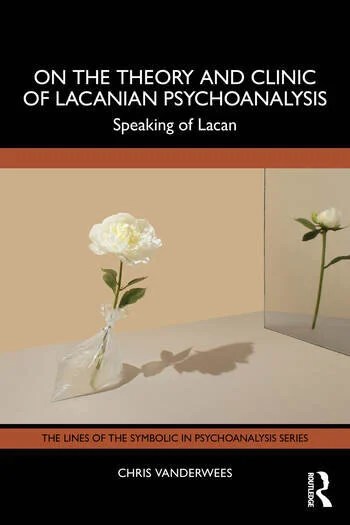
• Vanderwees, Chris. On the Theory and Clinic of Lacanian Psychoanalysis: Speaking of Lacan. London: Routledge, 2026. [Link]
Reviews
“This lively and informative book offers a fascinating panorama of Lacanian psychoanalysis, full of both conceptual developments and personal vignettes. Well-known Lacanian analysts speak of their own experience and practice, making complex psychoanalytic ideas accessible and showing their relevance to clinical work, as well as giving an insight into the personal trajectories of the clinician.” — Darian Leader, Ph.D., psychoanalyst; author, Strictly Bipolar and Is It Ever Just Sex?
“What is Lacanian psychoanalysis, and how is it practiced? This fundamental yet deceptively simple question is explored in Chris Vanderwees’ new volume in ways that expose the imaginary order projections that play a role in shaping our answers to this question. Serving as a companion book to On the History and Transmission of Lacanian Psychoanalysis, this collection of interviews with prominent Lacanian analysts lays bare what is essential to Lacanian psychoanalysis as a living clinical praxis. From work in private practice to barrios to crisis centers and with a variety of types of suffering, what comes to the fore is a plurality of analytic styles and approaches suited to the singularity of the patient and situated within a particular context.” — Stephanie Swales, Ph.D., psychoanalyst, Dublin City University; co-author, Psychoanalysing Ambivalence with Freud and Lacan: On and Off the Couch.
“This collection of powerful interviews sheds new light on what is possible for the human being when psychoanalysis offers the subject (in its suffering) a space that supports true speech. Refreshingly, the dialogues in this book make clear how various subject positions (e.g. psychotic, addict, trans) continue to expand the boundaries of psychoanalysis itself.” — Bret Fimiani, Ph.D., clinical psychologist; author, Psychosis and Extreme States: An Ethic for Treatment.
“Chris Vanderwees has written an exquisite volume on the theory and clinic of Lacanian psychoanalysis! True to the Freudian-Lacanian psychoanalytic method, Vanderwees uses free association to guide interviews with key figures in the Lacanian field. Offering glimpses into the worlds of Lacanian clinicians, this book reads like an intimate exploration of the foundational ideas guiding psychoanalytic practice today. The volume ends with a fascinating interview with Sylvia Lacan.” — Sheila L. Cavanagh, Ph.D., Professor, York University, Canada.
“Chris Vanderwees reminds us that ‘there can be no single Lacan’, in the preamble to this invigorating series of free association-sparked conversations conducted with many of the most eminent Lacanian analysts working today. That this is the case soon becomes abundantly clear in these wide-ranging and enlightening dialogues, which provide detail and texture to primary concepts in psychoanalysis – dreams, desire, trauma, the unary trait, the role of names, etc. – while foregrounding a series of new or previously under-emphasized priorities, such as transsexuality, historical consciousness, queer thanatology, the ‘missed encounter’, and more. This is something which Vanderwees intuitively grasps: the Lacanian field can only viably exist in such a distributed manner, by responding to, and being applied in, a wide variety of differing clinical and treatment contexts. Vanderwees sketches for us the landscape of this Lacanian field not only as it exists today but in view of the clinical challenges of an already arrived future.” — Derek Hook, Ph.D., Associate Professor of Psychology, Duquesne University; author, Six Moments in Lacan.
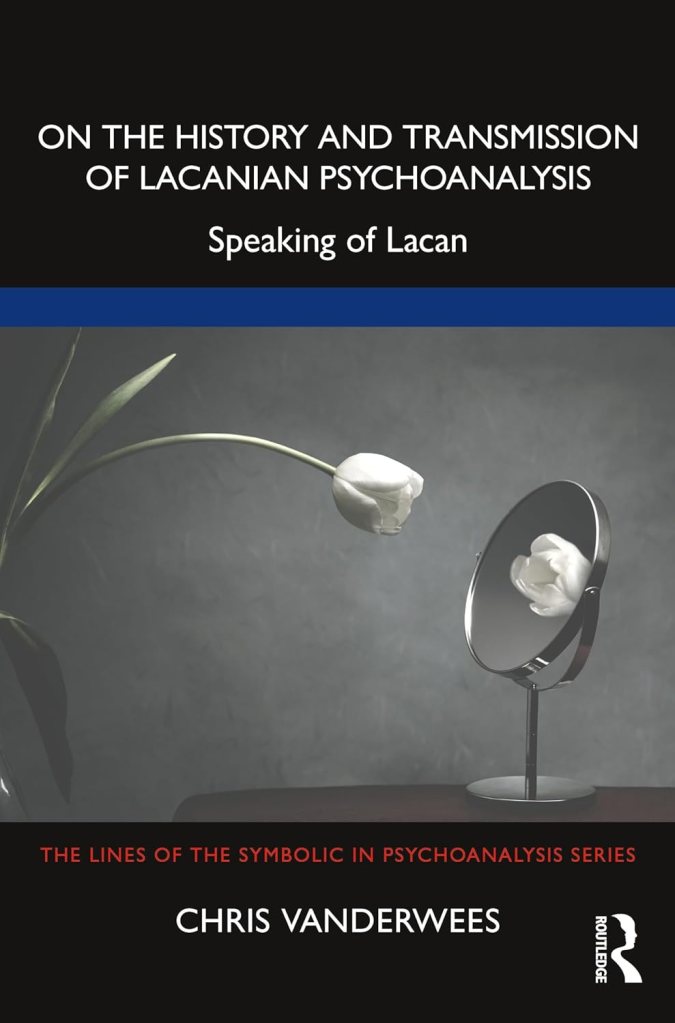
• Vanderwees, Chris. On the History and Transmission of Lacanian Psychoanalysis: Speaking of Lacan. London: Routledge, 2024. [Link]
Reviews
“On the History and Transmission of Lacanian Psychoanalysis reminds us of what is most revolutionary and subversive about Lacan’s psychoanalytic undertaking. Vanderwees traces multiple exploratory routes, mapping Lacanian discourse and practice as it has been utilized and revitalized at diverse institutional, global and historical sites. What emerges, in this careful and collaborative book, is a rich and textured overview, one which reminds us that there is no one Lacan, and that the Lacanian psychoanalytic adventure – like desire itself – necessarily resists domestication, uniformity, or a reduction to any one discourse of mastery.” — Derek Hook, Ph.D., Associate Professor of Psychology, Duquesne University; author, Six Moments in Lacan.
“In this book, Chris Vanderwees converses with significant figures in Lacanian psychoanalysis whose deeply personal relationships to psychoanalysis are interwoven with a tapestry of Lacanian movements they inspired in North America, Mexico, and Europe. The result is a vibrant collection beautifully rendered in conversations that exceed dialogics at every turn by contextually transmitting the desire of the analyst and the logic of Lacan’s formulations against scientific empiricism, the post-Freudian ‘institutionalisation’ of psychoanalysis, and dogmas of neoliberally-inspired therapies. The result is a book that serves as an important beacon of alterity, openness, and inspiration—literally the power of interlocution.” — Eve Watson, Ph.D., psychoanalyst; co-editor of Critical Essays on the Drive: Lacanian Theory and Practice.
“On the History and Transmission of Lacanian Psychoanalysis, Chris Vanderwees’s masterful collection of interviews with Lacanians, is like an all-access, backstage pass to the Coachella of psychoanalysis. They’re all here, the most important practitioners in the field today: from the Willy Apollon, Danielle Bergeron, and Lucie Cantin cohort in Québec to the Cormac Gallagher coterie in Ireland, from the Après-Coup New Yorkers to crucial Lacan translator Dan Collins, from knots with Ellie Ragland to welcome appendices on François Peraldi and William Richardson. Certain themes emerge that will engage – or perhaps enrage, or enrapture – readers: the usefulness of interpretation and clinical orthodoxies, the marginal status of Lacan in the Americas, on whether we should read Melanie Klein (or Jung!), and perhaps the most important question: is psychoanalysis dialectics? Only a reading of these dialogues will answer that question, and we are to thank Vanderwees for being a generous, and also rigorous, guide to the psychoanalytic scene today.” — Clint Burnham, Ph.D., Professor of English, Simon Fraser University.
“What would it mean to transmit our knowledge of psychoanalytic practice? Is this even possible? These questions, which are already questions of theory, of practice, of coherence, of ethics…of the very possibility of psychoanalysis itself, urgently require some response. This marvellous book gathers some such responses and opens up a vital conversation which is essential to the future of the discipline. It is essential reading for anyone and everyone interested in the field, whether as an analyst, a theorist or an analysand.” — Calum Neill, Ph.D., Associate Professor of Psychoanalysis & Cultural Theory, Edinburgh Napier University.
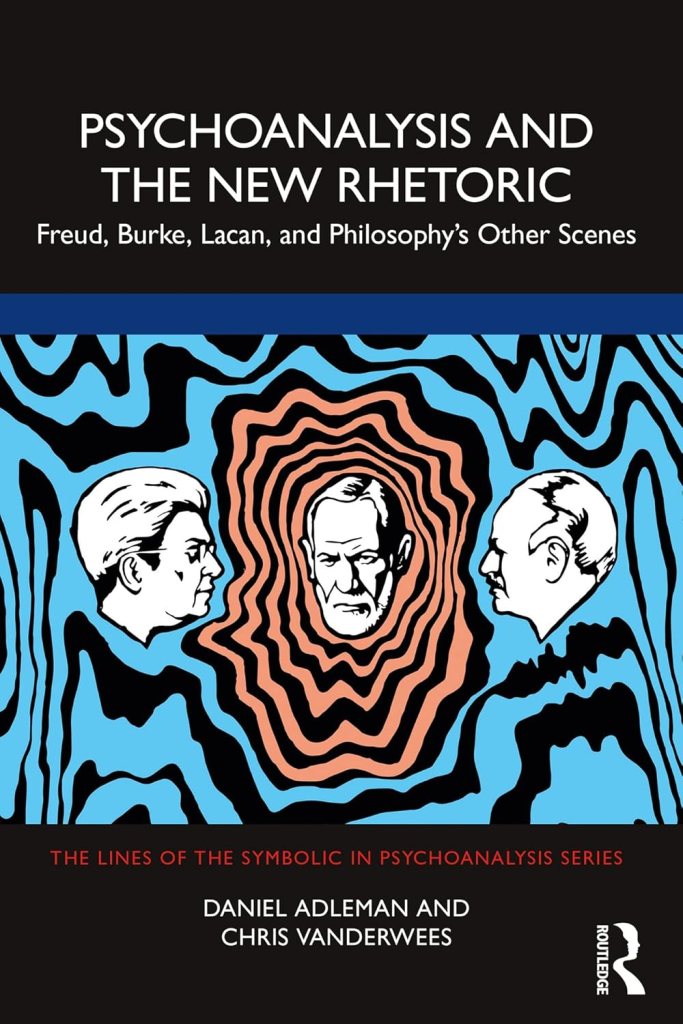
• Adleman, Daniel and Chris Vanderwees. Psychoanalysis and the New Rhetoric: Freud, Burke, Lacan, and Philosophy’s Other Scenes. London: Routledge, 2023. [Link]
○ Reviewed in Inscriptions. 6.2 (2023): 109-112. [Link]
○ Reviewed in Rhetoric & Public Affairs. 26.4 (2023): 137-141. [Link]
Reviews
“Daniel Adleman and Chris Vanderwees have performed a miracle. In Psychoanalysis and the New Rhetoric they lay out the manifold connections between psychoanalytic theory and rhetorical analysis that now seem clear and self-evident, but only because they have written this pathbreaking work. Picking up some clues left by Kenneth Burke, Adleman and Vanderwees take both psychoanalytic thinking and rhetoric where neither has gone before, uncovering how their shared territory is replete with new theoretical insights. For anyone who wants to consider either psychoanalysis or rhetoric, this book is impossible to miss.” — Todd McGowan, Ph.D., Professor of Film Studies at the University of Vermont; author of Emancipation after Hegel andCapitalism and Desire.
“In one of his last seminars, Lacan declared that the psychoanalyst is above all a rhetor, both an orator intent upon convincing an audience and a specialist of rhetoric. Psychoanalysis and the New Rhetoric argues cogently that Lacan’s return to Freud entailed the elaboration of a new rhetoric identical to what Kenneth Burke was teaching at the same time. Burke, like Lacan, a close reader of Freud, is shown to provide an innovative way of understanding the language of psychoanalysis. By detailing the multiple aspects of such a rhetoric, Adleman and Vanderwees offer an original thesis that radically modifies our conception of psychoanalysis.” — Jean-Michel Rabaté, Ph.D., Professor of English at the University of Pennsylvania, member of the American Academy of Arts and Sciences.
“Particularly for those engaging with Freudianism from Lacanian angles, it has long been appreciated that the unconscious of the ‘talking cure’ is ‘structured like a language.’ However, in Psychoanalysis and the New Rhetoric, Daniel Adleman and Chris Vanderwees, instead of relying solely on Saussurian linguistics and its offshoots, deftly utilize Burke’s rhetorical theory to renew and enrich our appreciation of the language-related dimensions of the theory, practice, and teaching of psychoanalysis. In so doing, Adleman and Vanderwees admirably demonstrate that only a multi-dimensional approach to language can do justice to psychoanalysis as an inherently interdisciplinary field.” — Adrian Johnston, Ph.D., Distinguished Professor of Philosophy at the University of New Mexico.
“This is a brave and brilliant book by Daniel Adleman and Chris Vanderwees which reads Burke’s revival of rhetoric as similar to many principles taken from Freud such as identification and free association. Rhetoric is a function of language for Burke and Lacan, offering psychoanalytic vitality. Lacan’s Seminars are portrayed as modes of listening to speech action and take rhetoric as their model. While Burke’s speaking symbol is not Lacan’s Symbolic, Lacan’s rhetoric displays thoughts in action. Lacan performed rhetoric in his Seminars with an attitude intended for an audience’s unconscious. Like Burke, Lacan aimed to persuade. The Other for both was fragmented and disunified. Lacan, like Burke, listened for metonymy, periphrastic, gaps, and so on. The Seminars were spontaneous speech, body and voice, an act of persuasion. Rhetoric and psychoanalysis are kindred disciplines that probe the unknowable limits of connection and eloquence.” — Ellie Ragland, Ph.D., Professor Emerita of English at the University of Missouri; authorof Jacques Lacan and the Logic of Structure.
“This volume stages an eloquent encounter between psychoanalysis and the rhetorical arts of persuasion, where the psychoanalytic relation is both an ethical and socio-symbolic address that takes place in and as language. Grounded in accessible and compelling contemporary examples, psychoanalysis and rhetoric emerge here as parallel histories, the symbolic / symptomatic action of each as the unconscious of the other. Psychoanalysis and the New Rhetoric brings to light an interdependence that was always there but is seldom theorised. In addressing this oversight, it makes a substantive interdisciplinary contribution to rhetorical studies, to psychoanalysis, and to the understanding of an increasingly anxious and polarizing political scene.” — Stuart J. Murray, Ph.D., Professor of Rhetoric and Ethics at Carleton University; author of The Living from the Dead: Disaffirming Biopolitics.
Translated Books
• Anzieu, Didier. Selected Writings from the French Journal of Psychoanalysis. Introduction and Translation by Chris Vanderwees. [Translated with permissions from original articles in La Revue Française de Psychanalyse]. Forthcoming.
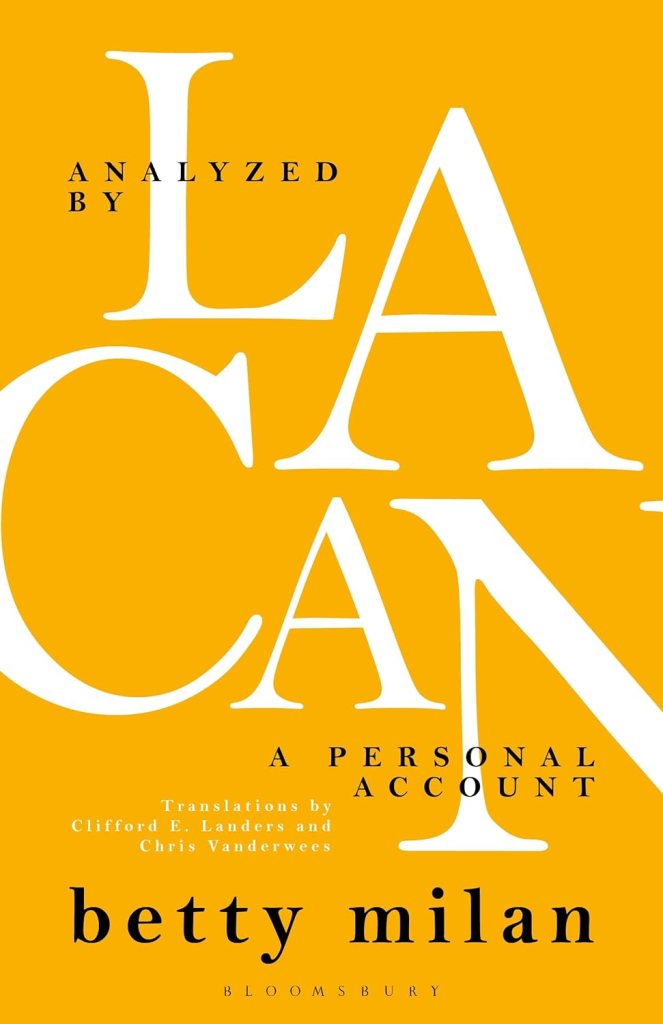
• Milan, Betty. Analyzed by Lacan: A Personal Account. Translation by Clifford E. Landers and Chris Vanderwees. London: Bloomsbury, 2023. [Translated with permissions from French: Milan, Betty. Pourquoi Lacan. Paris: Éditions Érès, 2021]. [Link].
○ Reviewed in Psychoanalysis, Culture & Society. 2024. [Link]
○ Interview in New Books in Psychoanalysis podcast, 15 April 2024. [Link]
○ Interview in Rendering Unconscious podcast, RU290. 28 March 2024. [Link]
○ Reviewed in The Times Literary Supplement. 8 March 2024. [Link]
○ Reviewed in Washington Independent Review of Books. 30 January 2024. [Link]
Reviews
“Betty Milan’s portrait of Lacan destroys the clichés collected about him like his antics and opaque riddles. Using both memoir and theatrical staging, Milan defines the conditions for a successful psychoanalysis, that exercise in mutual trust and openness. In the end, Lacan appears as wise but not infallible, a human being like us all, yet determined to let the truth speak.” — Jean-Michel Rabaté, Ph.D., Professor of English and Comparative Literature, University of Pennsylvania, USA, and Fellow of the American Academy of Arts and Sciences.
“It is astonishing and almost miraculous that Milan has succeeded to evoke her analysis with Lacan with such clarity and precision. She has managed to turn it almost into a thriller. I read the book with curiosity, interest, and pleasure. It responds to all the questions that the non-initiated might have about the mysterious analytic sessions that Lacan conducted. In addition, as a writer, Milan transforms her analytic testimony into a literary feat.” — Michèle Sarde, Ph.D., Professor Emerita of French Literature, Georgetown University, USA.
“A stunning introduction to Lacan’s theoretical and clinical work. How better to appreciate the thinking and practice of this exceedingly important theoretician and clinician than to bear witness to an insider’s experience, to feel it almost as one’s own? Captivating reading not only by a former analysand but by a seasoned writer who truly knows her way around words.” — Lois Oppenheim, Ph.D., University Distinguished Scholar, Professor of French, and Chair of the Department of Modern Languages and Literatures at Montclair State University, USA.
Edited Collections
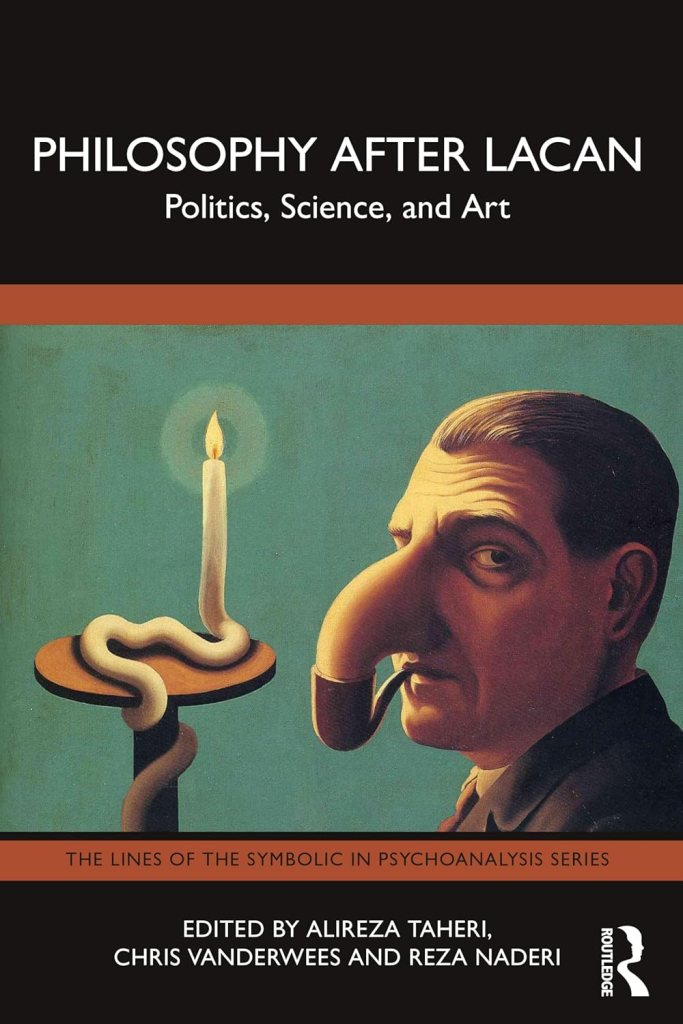
• Taheri, Alireza, Chris Vanderwees, and Reza Naderi (eds). Psychoanalysis After Lacan: Politics, Science and Art. London: Routledge, 2024. [Link]
○ Reviewed in Psychoanalysis, Culture & Society. 2025. [Link]
Reviews
“This book extends the ethics of Lacanian psychoanalysis in the clinic to the symbolic and real. Philosophy After Lacan: Politics, Science and Art is a marvellous collection of essays testifying to the vitality and timeliness of Lacan’s ideas. Most extant examinations of Lacan’s relations with philosophy tend to restrict themselves to situating Lacan historically vis-à-vis philosophers and philosophical orientations of the past. By welcome contrast, Philosophy After Lacan focuses on how Lacanian thought enables today’s philosophers and theorists to develop new and original approaches to a range of fields and topics across the theoretical humanities. There is no more convincing demonstration that Lacanianism is a living and fruitful tradition than this superb volume of papers.” — Adrian Johnston, Ph.D., Distinguished Professor, Department of Philosophy, University of New Mexico.
“Antiphilosophy is an ambivalent term and Lacan caused much provocation, irritation, and misunderstanding, when he applied it to his own teaching. But rather than simply rejecting philosophy, Lacan’s antiphilosophical position invites both philosophers and psychoanalysts not to forget to constantly challenge their practices from within, for this is what makes these practices, theoretical and clinical, alive. The contributions in this volume, meticulously edited, show how the practice of philosophy looks like, when Lacan’s challenge is taken seriously, that is, beyond provocation. They demonstrate that philosophy and psychoanalysis have always entertained a relation of seduction and entanglement. This relation, troubled and critical at times, is in truth a love relation.” — Samo Tomšič, Ph.D., Professor of Philosophy, University of Fine Arts Hamburg.
“Moving across fields as diverse as neuroscience, theology, mathematics, continental philosophy, linguistics and politics, this incredible collection – a veritable ‘dream team’ of Lacanian thinkers and scholars – demonstrates how the multiple trajectories of Lacanian ‘anti-philosophy’ have inflected contemporary thought today in a way which is both irreversible and profound. We have, in recent decades, heard of the linguistic and affective turns in social theory. This seminal volume tracks the impact of the Lacanian turn in cultural theory today.” — Derek Hook, Ph.D., Associate Professor of Psychology, Duquesne University; editor, Lacan on Depression and Melancholia (with Stijn Vanheule).
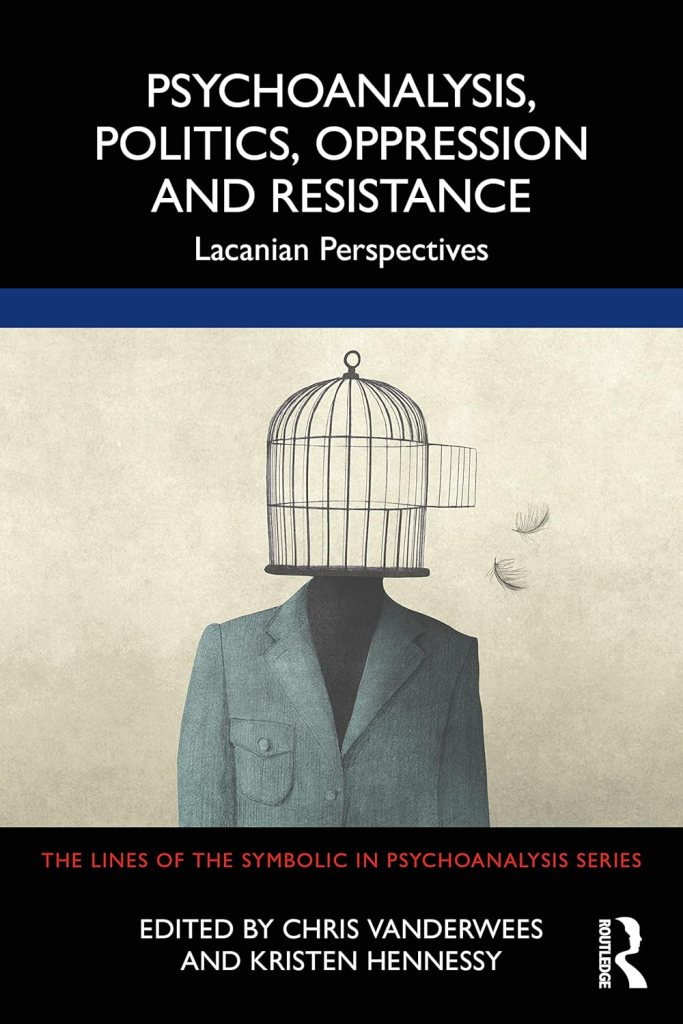
• Vanderwees, Chris and Kristen Hennessy (eds). Psychoanalysis, Politics, Oppression and Resistance: Lacanian Perspectives. London: Routledge, 2022. [Link]
○ Reviewed in Psychoanalysis, Culture & Society. 28 (2023): 355–357. [Link]
○ Reviewed in Free Associations. 90 (2023): 67-68. [Link]
Reviews
“This book extends the ethics of Lacanian psychoanalysis in the clinic to the symbolic and real beyond the clinic. The position of the analyst in the world is crucial for our time, and this book gathers some of the wisest, clearest voices in our field.” — Annie G. Rogers, Ph.D., Psychoanalyst, Lacanian School of Psychoanalysis; Professor Emerita of Psychoanalysis and Clinical Psychology, Hampshire College.
“An extraordinary collection, which foregrounds and advances the radical progressive impulse that has arguably always been inherent in Lacanian clinical social theory. Moving from questions of political emancipation, capitalist jouissance and Lacan’s Marx, to the pragmatic concerns of homelessness, immigrant identity, violence and community mental health – and, of course, the paramount concern of how we might effectively decolonize Lacan – this volume makes an invaluable contribution to how we might reframe and respond to the most pressing socio-political and ideological dilemmas of our times.” — Derek Hook, Ph.D., Associate Professor of Psychology, Duquesne University; author of Six Moments in Lacan.
“These urgent and original essays by experienced clinicians and distinguished scholars reclaim the too often disavowed political power of the unconscious, thus freeing psychoanalysis as a tool for social change. This stellar collection is a work of emancipatory radicality that changes the way we think about and with psychoanalysis.” — Patricia Gherovici, Ph.D., Psychoanalyst; author of Transgender Psychoanalysis: A Lacanian Perspective on Sexual Difference.
Edited Volumes
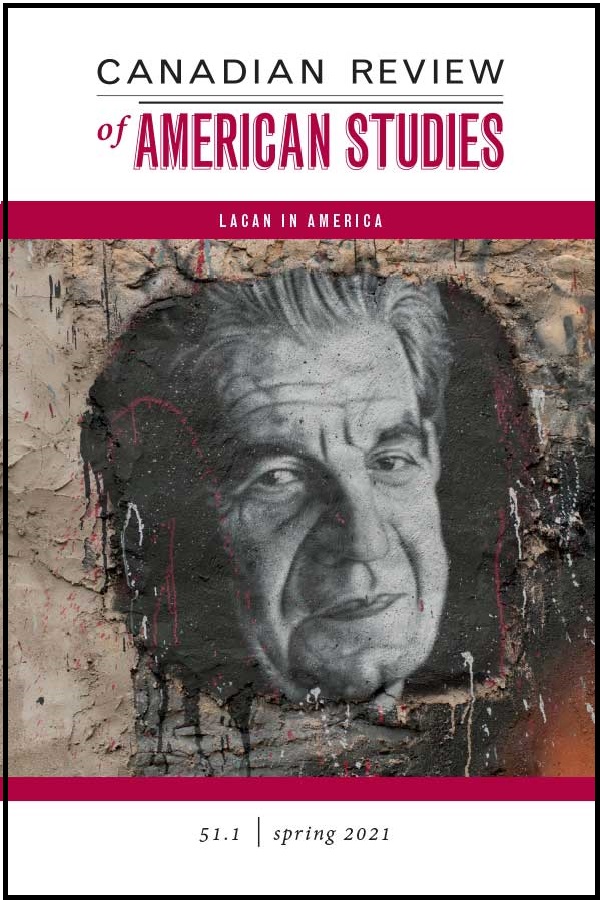
• Vanderwees, Chris. “Introduction – Lacan in America.” Spec. issue of Canadian Review of American Studies. 51.1 (2021): 1-3. [Link]
• Chau, Jonathan and Chris Vanderwees. “Introduction – High Fantasy, Political Dreams, and the Mainstream: Reflections on Game of Thrones.” Spec. issue of Canadian Review of American Studies. 49.1 (2019): 1-6. [Link]
• Vanderwees, Chris and Andrew Connolly. “Introduction – Lynching and Its Legacies: Racial Dynamics of Discipline and Punishment in American Culture.” Spec. issue of Canadian Review of American Studies. 48.1 (2018): 1-9. [Link]
○ Translated as “Introduction – Le legs du lynchage: dynamique raciale de la discipline et de la punition dans la culture étatsunienne.” Spec. issue of Canadian Review of American Studies. 48.1 (2018): 10-19. [Link]
Papers in Refereed Journals
• Adleman, Daniel and Chris Vanderwees. “Mad Men and the Falling Bodies of 9/11.” Canadian Review of American Studies. 52.3 (2022): 229-240. [Link].
• Adleman, Daniel and Chris Vanderwees. “Lacan’s Psychoanalytic Rhetoric and the Power of Non-Understanding.” Lacan Now. Spec. issue of English Studies in Canada. 47.2-3 (2021): 201-227.
○ Reprinted in Adleman, Daniel and Chris Vanderwees. Psychoanalysis and the New Rhetoric: Freud, Burke, Lacan and Philosophy’s Other Scenes. London: Routledge, 2023. 140-162.
• Vanderwees, Chris. “Dwelling on the Direction of the Treatment for the Homeless Subject.” Psychoanalytische Perspectieven. 38.4 (2020): 411-423. [Link].
○ Reprinted in Vanderwees, Chris and Kristen Hennessy (eds). Psychoanalysis, Politics, Oppression and Resistance: Lacanian Perspectives. London: Routledge, 2022. 67-78. [Link].
• Adleman, Daniel and Chris Vanderwees. “Covid’s Metamorphoses: The Derangement of the Atmospheric Unconscious.” Enduring Pandemic: Further Transmissions from Psychoanalysts & Philosophers. Spec. issue of European Journal of Psychoanalysis. (2020): n. pag. Web. [Link].
• Vanderwees, Chris. “The Social Imaginary of Ruination: Psychoanalytic Reflections on Disaster Mediation.” Canadian Journal of Communication. 45.4 (2020): 545-566. [Link].
• Vanderwees, Chris. “Symptom to Skinthome: A Psychoanalytic Skinthesis.” Canadian Journal of Psychoanalysis. 28.1 (2020): 75-85. [Link].
• Vanderwees, Chris. “Care of the (Incarcerated) Self: Ethics and Parrhēsia in the Prison Writing of Jack Henry Abbott.” The CEA Critic: Official Journal of the College English Association. 82.1 (2020): 23-37. [Link].
• Vanderwees, Chris. “Mouth at Rest: Notes on Silence as Psychoanalytic Technique.” Lacanian Psychoanalytic Technique Today. Spec. issue of Psychoanalytische Perspectieven. 37.3 (2019): 837-846. [Link].
• Vanderwees, Chris. “Paranoid Pleasure: Surveillance, Online Pornography, and Scopophilia.” Porn on the Couch: Sex, Psychoanalysis, and Screen Cultures / Memories. Spec. issue of Porn Studies. 6.1 (2019): 23-37. [Link].
○ Reprinted in Porn on the Couch: Sex, Psychoanalysis, and Screen Cultures / Memories. Edited by Ricky Varghese. London: Routledge, 2023. 20-34. [Link]
• Vanderwees, Chris. “Traces of the Virtual: Aesthetics, Affect, and the Event in Joel Meyerowitz’s Photography of Ground Zero.” Photography and Culture. 10.1 (2017): 19-36. [Link]
• Vanderwees, Chris. “Ego Portrait: Self-Photography as Symptom in Contemporary Technoculture.” Lacunae: APPI International Journal for Lacanian Psychoanalysis. 15 (2017): 95-111. [Link].
○ Reprinted in The Body in Theory: Essays After Lacan and Foucault. Edited by Becky McLaughlin and Eric Daffron. Jefferson: Mcfarland & Company, 2021. 115-123. [Link].
• Vanderwees, Chris. “Traces of Austerity, or the Writing on The Wall.” Public Space: Between Spectacle and Resistance. Spec. issue of Streetnotes: Ethnography, Poetry and the Documentary Experience. 25 (2016): 153-161. [Link].
• Vanderwees, Chris. “Photographs of Falling Bodies and the Ethics of Vulnerability in Jonathan Safran Foer’s Extremely Loud and Incredibly Close.” Canadian Review of American Studies. 45.2 (2015): 174-94. [Link].
• Vanderwees, Chris. “Complicating Eroticism and the Male Gaze: Feminism and Georges Bataille’s Story of the Eye.” Studies in Twentieth & Twenty-First Century Literature. 38.1 (2014): 1-19. [Link].
• Vanderwees, Chris. “Bank Street: A Photographic Essay.” Photo Essay. Spec. issue of Streetnotes: Ethnography, Poetry and the Documentary Experience. 22 (2014): 1-28. [Link].
• Vanderwees, Chris. “Sartorial Signifiers, Masculinity, and the Global Recession in HBO’s Hung.” Jump Cut: A Review of Contemporary Media. 55 (2013): Web. [Link].
• Vanderwees, Chris. “9/11 Allegory, Conspiracy Theories, and Communicative Capitalism in William Gibson’s Pattern Recognition.” The CEA Critic: Official Journal of the College English Association. 74.2-3 (2012): 73-87. [Link].
• Vanderwees, Chris. “Resisting Remasculinization: Tim O’Brien’s ‘Sweetheart of the Song Tra Bong.'” Feminist Studies in English Literature. 17.2 (2009): 191-210. [Link].
○ Reprinted in Short Story Criticism. 239 (2017): 273-279. [Link].
• Vanderwees, Chris. “Companion Species under Fire: A Defense of Donna Haraway’s The Companion Species Manifesto.” Nebula: A Journal of Multidisciplinary Scholarship. 6.2 (2009): 73-81. [Link].
Chapters in Books
• Vanderwees, Chris. “Freud’s Beyond the Pleasure Principle and the Death Drive: A Concise Overview.” Critical Essays on the Drive: Lacanian Theory and Practice. Edited by Dan Collins and Eve Watson. London: Routledge, 2024. 67-76. [Link]
• Vanderwees, Chris. “Lacan with Derrida.” Philosophy after Lacan: Politics, Science and Art. Edited by Alireza Taheri, Chris Vanderwees, and Reza Naderi. London: Routledge, 2024. 127-141. [Link]
• Vanderwees, Chris. “Erich Fromm’s Psychoanalysis of Transcendence and the Photography of Detroit’s Ruins.” Progressive Psychoanalysis: Essays on Psychoanalysis as a Social Justice Movement. Edited by Scott Graybow. Newcastle: Cambridge Scholars Publishing, 2017. 42-66. [Link].
• Vanderwees, Christopher. “A Tightrope at the Twin Towers: Photographs of Falling Bodies and James Marsh’s Man on Wire.” Recovering 9/11 in New York. Edited by Robert Fanuzzi and Michael Wolfe. Newcastle: Cambridge Scholars Publishing, 2014. 228-248. [Link].
• Murray, Stuart J. and Chris Vanderwees. “Unborn and Born-again Victims: Governing Life through the Unborn Victims of Violence Act of 2004.” Security, Life, and Death: Governmentality and Biopower in the Post-9/11 Era. Edited by Claudio Colaguori. Whitby: de Sitter Publications, 2013. 61-85. [Link].
Translated Articles
• Anzieu, Didier. “Beckett: Self-Analysis and Creativity.” Translation by Chris Vanderwees. Psychoanalytic Discourse. 6.1 (2023): 56-85. [Translated with permissions from the original: Anzieu, Didier. “Beckett: Auto-analyse et créativité.” Revue française de psychanalyse. 56.2 (1992): 357-370]. [Link].
• Anzieu, Didier. “New Views on Freud’s Self-Analysis and the Discovery of Psychoanalysis (Vienna, July 23, 1988).” Translation by Chris Vanderwees. American Imago. 78.3 (2021): 463-484. [Translated with permissions from original: Anzieu, Didier. “Vues nouvelles sur l’auto-analyse de Freud et la découverte de la psychanalyse (Vienne, 23 juillet 1988).” Revue française de psychanalyse, 64.4 (2000): 1201-1216]. [Link].
• Anzieu, Didier. “Psychoanalysis Still.” Translation by Chris Vanderwees and Ian Birksted. International Journal of Psychoanalysis. 102.1 (2021): 109-116. [Translated with permissions from original: Anzieu, Didier. “La Psychanalyse Encore.” Revue française de psychanalyse. 39.1-2 (1975): 135-146]. [Link].
• Anzieu, Didier. “Note to Introduce Levels of Symbolization.” Translation by Chris Vanderwees. Canadian Journal of Psychoanalysis. 28.1 (2020): 66-74. [Translated with permissions from original: Anzieu, Didier. “Note pour introduire l’échelle des symbolisations.” Revue française de psychanalyse. 53.6 (1989): 1775-1778]. [Link].
Interviews
• Vanderwees, Chris. “Hand Grenade Film: Review and Conversation with Richard C. Ledes on Adieu Lacan.” Psychoanalysis, Culture and Society. 28 (2023): 635-648. [Link]
• Hennessy, Kristen and Chris Vanderwees. “A Conversation on Psychoanalytic Work with Children in the System.” Psychoanalysis, Politics, Oppression and Resistance: Lacanian Perspectives. Edited by Chris Vanderwees and Kristen Hennessy. London: Routledge, 2022. 110-117. [Link].
• Vanderwees, Chris. “Free Association, Presence, and Patience: A Conversation with William (Moe) Robinson.” Psychoanalytic Discourse. 5.1 (2020): 51-70. [Link].
• Vanderwees, Chris. “Treating Psychosis in Québec: A Conversation with the Founders of GIFRIC and the 388 [Willy Apollon, Danielle Bergeron, and Lucie Cantin].” Museum of Dreams. Edited by Sharon Sliwinski. Translated by Daniel Wilson. 2019. Web. [Link].
• Vanderwees, Chris. “Reflections on Training Institutions and the San Francisco Bay Area Lacanian School of Psychoanalysis, An Interview with Raul Moncayo.” Lacunae: APPI International Journal for Lacanian Psychoanalysis. 19 (2019): 8-37. [Link].
Book Reviews
• Vanderwees, Chris. “Lacan, Psychoanalysis, and Comedy, Patricia Gherovici and Manya Steinkoler (eds).” Canadian Journal of Psychoanalysis. 27.2 (2019): 340-344.
• Vanderwees, Chris. “Talking to Brick Walls: A Series of Presentations in the Chapel at the Sainte-Anne Hospital, Jacques Lacan (Translated by A. R. Price).” Psychoanalytic Discourse. 4.1 (2019): 104-108. [Link].
• Vanderwees, Chris. “The Trouble with Pleasure: Deleuze and Psychoanalysis, Aaron Schuster.” Canadian Journal of Psychoanalysis. 24.2-25.1 (2016-2017): 240-243.
• Vanderwees, Chris. “Lacanian Affects: The Function of Affect in Lacan’s Work, Colette Soler (Translated by Bruce Fink).” Canadian Journal of Psychoanalysis. 24.1 (2016): 142-145.
• Vanderwees, Chris. “The Violence of the Image: Photography and International Conflict, Liam Kennedy and Caitlin Patrick (eds).” PUBLIC. 52 (2015): 253-54. [Link].
• Vanderwees, Chris. “Of Aesthetic Experiments and Affective Encounters: Senses of Embodiment: Art, Technics, Media, Mika Elo and Miika Luoto (eds).” Philosophy of Photography. 5.2 (2014): 171-73. [Link].
• Vanderwees, Chris. “Feeling Photography, Elspeth H. Brown and Thy Phu (eds).” Philosophy of Photography. 5.1 (2014): 81-83. [Link].
Other Publications
• Vanderwees, Chris. “Effects Theory.” The SAGE International Encyclopedia of Mass Media and Society. Edited by Debra L. Merskin. Thousand Oaks: SAGE Publications, 2019. 528-530. [Link].
• Vanderwees, Chris. “Dreams of Destruction.” Museum of Dreams. Edited by Sharon Sliwinski. 2018. Web. [Link].
• Vanderwees, Chris. “Cheney, Richard B., ‘Dick'” and “Wolfowitz, Paul Dundes.” Imperialism and Expansionism in American History: A Social, Political, and Cultural Encyclopedia and Document Collection. Edited by David Bernstein and Chris Magoc. Santa Barbara: ABC-CLIO, 2015. 1440-41; 1491-92. [Link].
• Vanderwees, Chris. “Freud, Sigmund.” The Social History of the American Family: An Encyclopedia. Edited by Lawrence Ganong and Marilyn Coleman. Thousand Oaks: SAGE Publications, 2014. 586-88. [Link].
• Vanderwees, Chris. “Implants,” “Klein, Melanie Reizes,” “Love, Dr. Susan,” “Man-Bras,” “Training Bras,” “Wonder Bra.” Cultural Encyclopedia of the Breast. Edited by Merril D. Smith. Lanham: Rowman & Littlefield Publishers, 2014. 136-37; 145-46; 152-53; 157-58; 242-43; 270-71. [Link].
• Vanderwees, Chris. “Aesthetics of Terror: Reflections on Post-9/11 Literature and Visual Culture.” 2014. Carleton University. Ph.D. dissertation. [Link].
 Chris Vanderwees, PhD, RP